Sunday, January 22, 2017

TOW #16: Kansas-Nebraska Act Political Cartoon

Political Cartoon
(http://cf.collectorsweekly.com/uploads/2014/10/Slavery_Free_Soiler_cartoon.jpg)

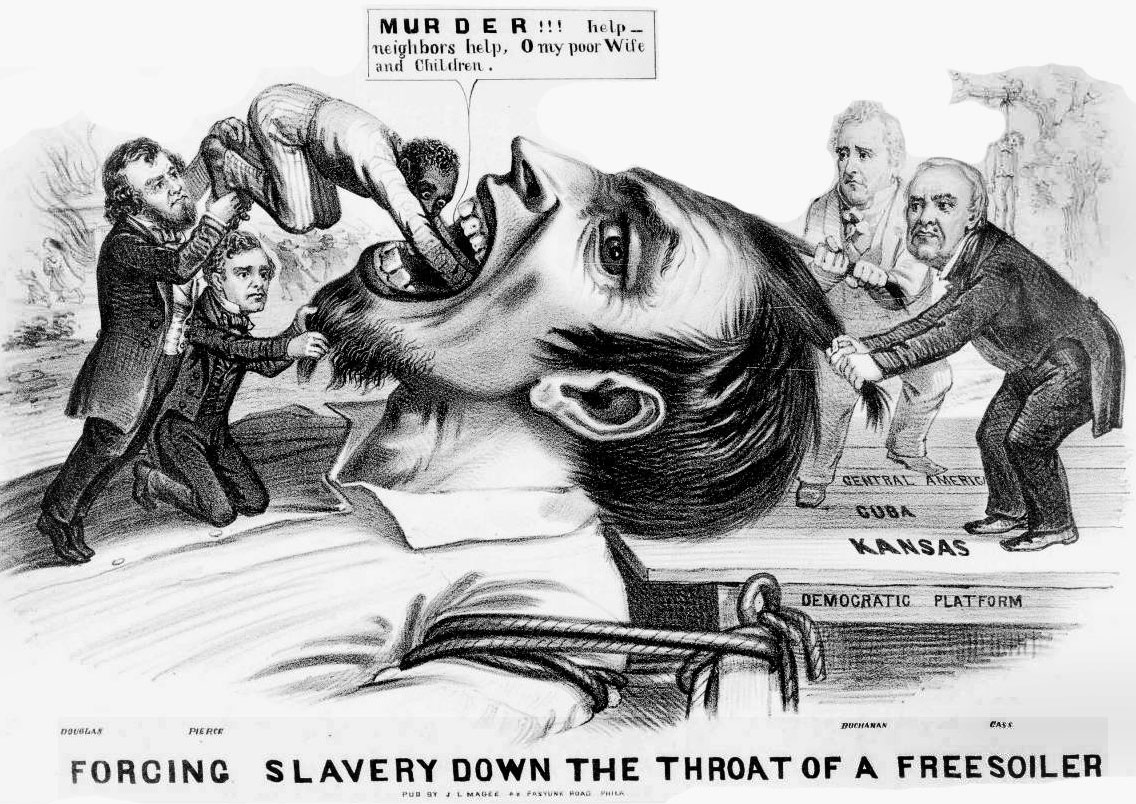
In 1820, the Missouri Compromise was passed to keep the balance between free and slave state power. It declared that slavery was illegal in the future Western states north of the 36º30’ latitude line. However, thirty-four years later, democratic congressman Stephen Douglas pushed to repeal this act and enact the Kansas-Nebraska act. This law would admit the Kansas and Nebraska territories, both north of the 36º30’, as states and would allow the people of the territories to vote on whether slavery was admitted or not. Since this directly went against their initial agreement with the South about slavery, the North was outraged. Additionally, the South was secretly scouting out possible slave states in Central America and Cuba. When the North found out, tensions grew even greater, and they felt as if the South (especially the southern Democrats) was “forcing slavery down [their] throats.” Since the Democrats seemed to be forcing the issue of slavery on the northern free soilers, the North created this cartoon to lash out against them, using gruesome imagery and literal representations to express their concerns.

The cartoon contain lots of gruesome imagery, such as the slave being shoved down the throat of a man by four democratic figureheads, a burning house with a mother and her children fleeing from it, and the lynching of a man. All of these scenes are used to draw out the audience’s (the people of the North) fear of and hatred for the Democratic Party, whose actions are being portrayed as heinous. This creates the effect that because of the its actions, it raised has raised violent conflicts against everyone regardless if they are a father, a mother, or a child. It shows the Democrats as the aggressors which successfully pushes the audience to outcry against such actions.

This cartoon also uses the literal representation of the conflict. This includes a literal interpretation of the idiom “to force something down one’s throat” as a slave being forced down the free soiler’s throat and of the Democratic platform as a literal platform. Because of this, it is easy for the audience to interpret the main problem at hand, easily moving people to have a public outcry against this problem.

Overall, this cartoon portrays the northern free soiler view of the Kansas-Nebraska Act along with their view of the south trying to expand to Latin America as a ploy to strengthen southern power and slavery. Through its imagery and literalness, it successfully conveys its point and contributed to the uprising against this act that led to the rise of the Republican Party.

Monday, January 16, 2017

TOW #15: IRB, The Grand Design by Leonard Mlodinow and Stephen Hawking

In The Grand Design by Leonard Mlodinow and Stephen Hawking, it talks about new theories of quantum physics that explain the existence of many paradoxical situations in the universe. Before these theories, traditional physicists could not logically explain how these situations work. This modern idea quantum physics has helped put a dent in understanding the perplexities of the universe, and it is the purpose of this book to share these new findings with the world.

Of course, since many of their theories are used to explain the unexplainable, Hawking and Mlodinow have to convey the information in a certain way in order to allow the audience to have a clear understanding of it. They do this by creating a problem-solution structure in each chapter, where they pose a problem that seems to be impossible to solve, and then they explain it using their theories.

Hawking and Mlodinow do this one way by posing the problem in a straightforward way. For example, they say, "The problem is, for our theoretical models of inflation to work, the initial state of the universe had to be set up in a very special and highly improbable way." (130). Their scientific, yet common, diction (e.g. saying “improbable”) allows them to introduce the problem. However, many times they introduce the problem using rhetorical questions. For example, they say, “If the total energy of the universe must always remain zero, and it costs energy to create a body, how can a whole universe be created from nothing?” (180). This is a great example of a paradox by asking the reader how the universe can be created from nothing because it perplexes and stumps them. They are forced to come up with a way to explain it, paving the way for the authors to give their theories that explains it. Rhetorical questions are utilized very effectively and they help to move the book forwards through its problem-solution structure.

Overall, Stephen Hawking and Leonard Mlodinow are posed with the difficult task of using quantum physics to explain complicated and seemingly-impossible situations that occur in the universe. However, they are able to effectively explain their ideas using their problem-solution structure, and it is through this, that they are able to help the common people to further understand where we originated from and how the universe works.

The Universe
(http://ichef.bbci.co.uk/wwfeatures/wm/live/1280_640/images/live/p0/3x/sw/p03xsw49.jpg)

Saturday, January 7, 2017

TOW #14: The Speech of Alexander the Great


In 335 B.C., Alexander the Great and his army began a conquest to expand the Greek Empire. For ten years, they went undefeated in all the battles they fought and they had successfully conquered Egypt and the vast Persian Empire. However, power-thirsty Alexander lusted for more and decided to continue his conquest to India. The men, who had become weathered by all the years of warring, had low morale and lacked the will to continue the conquest any longer. In his powerful speech, Alexander the Great used rhetorical questions, rallying diction, and a strong balance between logos and pathos in order to motivate his men to continue on.

In the beginning part of his speech, Alexander the Great used empowering rhetorical questions and diction to force his men to realize how strong they were and make them thirsty for more. After listing all of the places they had conquered, Alexander says, “With all that accomplished, why do you hesitate to extend the power of Macedon− your power− to the Hyphasis and the tribes on the other side? Are you afraid that a few natives who may still be left will offer opposition?” In the first question, he emphasizes “your power” in order to make his troops realize their great abilities and show that a little more conquesting will not pose a threat. Then, in the second question, he plays the “scaredy-cat” card, teasing his men and their dignity. He asks his men if they are scared of “a few natives” as reverse psychology to make his men realize that fighting means keeping their dignity.

In the central part of his speech, Alexander the Great transitions by using a more logical approach. He explains to his men that if they do not conquest India, then someone else will. He says, “Should that happen, all that we have done and suffered will have proved fruitless--or we shall be faced with the task of doing it over again from the beginning.” For the sake of progress, he able to convince his men that if they do not conquest India, all of their past conquests were for nothing and they might have to start over. This appeal to the soldiers’ logos forces them to understand that the only logical option is to continue on.

In the end, Alexander the Great transitions back to appealing to the soldiers’ pathos by glorifying them and using a “we are in this together attitude.” He says, “We have passed beyond Nysa and we have taken the rock of Aornos which Heracles himself could not take.” Alexander focuses on the fact that his men has taken land that Heracles, a demigod known to be stronger than any man and even some gods in Greek mythology. This is a rallying call for the soldiers because if they can conquer land that Heracles cannot, what can’t they do? He continues, and says, “You and I, gentlemen, have shared the labour and shared the danger, and the rewards are for us all.” His word choice of “you and I” helps to unify his men and make them feel a bond through the battles they fought. By ending this way, he paves the path to continuing the conquest to India.

Alexander the Great’s ambitions did not line up with those of his men, who were tired of fighting, and he realized that they needed to be motivated for one last conquest. By using his awe-inspiring oration skills learned from the great Aristotle, he was able to successfully rally his men and continue on to India.

To read his speech, click here.

Alexander the Great
(http://www.pindex.com/uploads/board_cover_images/original/image_2522.jpg)