Sunday, May 7, 2017

TOW #28: Lyndon B. Johnson's "Daisy Attack" Advertisement

Video: https://www.youtube.com/watch?v=dDTBnsqxZ3k

America in the 1960s was plagued with a fear of communism and the fear of a possible nuclear war with the Soviet Union. Politics during this time played heavily off of this fear, and during the presidential election of 1964, Lyndon B. Johnson used this fear to win the election with an anti-nuclear bomb advertising campaign. In his famous “Daisy Attack” advertisement, the Johnson campaign uses serene imagery juxtaposed with violent imagery and an extreme appeal to sympathy in order to convince the American people that he is the right choice for the election.

In its “Daisy Attack” advertisement, the Johnson juxtaposes a calm scene and quickly snaps to a scene filled with violence in order to instill fear into the audience. The advertisement begins with a young girl counting the petals of a flower, counting up from one. This pulls watchers in, as they watch and are filled with emotions. Then, the girl looks up at the sky in response to someone counting down from 10. When the timer reaches zero, a nuclear bomb goes off, implying the girl was enveloped in the explosion. This dramatic shift instills fear into the audience as they watch a little girl instantly become a victim of nuclear war. The purpose drawing this reaction from the audience was to make them feel like Johnson would protect them from an event like this from ever happening. Watchers sympathize with the girl, who was just killed, which was supposed to make people obligated to vote for Johnson.

However, this advertisement campaign blew up in Johnson’s face, as he instilled too much fear into his audience. Viewers became terrified, as it made nuclear war seem so close to happening. Because of this unsuccessful, and even countactive, approach to get people to want to vote for Johnson, this advertisement was taken down within days. Despite all this, other advertisement in Johnson’s advertising campaign saved him by only instilling mild amounts of fear, helping to win him the presidential election of 1964.

(http://www.chicagonow.com/politics-now/files/2016/07/daisy.jpg)

Sunday, April 30, 2017

TOW #27: "Click: What Millions of People Are Doing Online and Why It Matters," by Bill Tancer


In Click: What Millions of People Are Doing Online and Why It Matters, Bill Tancer describes the psychology behind what people are clicking on when browsing the internet. He then applies this psychology to how people think, allowing us to understand how we tick. Throughout the text, he uses a scholarly tone, graphs, and hypophora in order to uncover a deeper truth about the psychology about why we do certain activities while online.

Tancer maintains a scholarly tone throughout the text in order to establish ethos on the subject and to be more convincing to his readers. For example, he says, “An interesting corollary to this concept of measuring political thought processes through clickstream data is the use of this same data to understand political bias in traditional news coverage” (46). Using words, such as “corollary,” and technical jargon, such as “clickstream,” Tancer is able to show that he is both a credible source of information and educated in the topic. This allows him to convey his message to readers in a more convincing way that makes his readers question his credibility less.

Tancer also uses graphs to support his ideas and provide background statistics that help readers come to the same deductions that Tancer does. Providing graphs also gives visuals for people who are more visual learners, broadening his audience. Since these graphs are based off of real statistics from credible third-party sources, he is able to establish a stronger sense of ethos.

At the beginning of most chapters, Tancer uses hypophora to introduce his ideas and transition from previous chapters to the current chapter. In Chapter 10, a chapter that talks about finding early adopters to a specific site, Tancer asks, “Do you ever wonder how innovation spreads from an idea to mass adoption?” (171). By asking this broad question at the beginning of the chapter, he can spend the rest of the chapter delving into this topic and answering the question. This structure provides a great way for Tancer to get his readers to question the same things he does, and then transition into the idea at hand.

Throughout Click, Tancer uses his rhetoric in order to discover the true psychology behind what people do online and why. He is able to successfully get his ideas across to his readers as writes in a way that gets readers excited about the topic as well.

Image result for internet

Sunday, April 23, 2017

TOW #26: "What is the Monkeysphere?" by David Wong

In his article “What is the Monkeysphere?”, David Wong writes about the Monkeysphere theory, discussing that there’s a certain limit to the number of people that we can conceptualize as people and anyone outside this circle of people are seen more things. This explains why the death of a friend or family member can be traumatizing, while the massacring of a thousand people on the other side of the world is only a mere statistic. Wong uses hypophora and a blunt, colloquial tone in order to explain this Monkeysphere theory and to convey how we can be more mindful people.

Wong structures his article in a strict fashion, where he uses hypophora to drive the article forwards and transition between different concepts. More specifically, the questions that he asks are questions that he predicts we may have in our heads. For example, when transitioning between explaining what the Monkeysphere is and telling readers why it is important, he asks, “So what exactly are we supposed to do about all this?” Since he spent most of his time explaining what this theory entails, he knows that the readers might be wondering why he is talking about it. This hypophora allows him to transition into talking about how we can apply this concept to life and the real world.

Along with using this strict structure of writing, he utilizes a blunt, colloquial tone to better connect with readers and to give his straightforward, no-fluff thoughts. When talking about why people should understand this idea of the Monkeysphere, he gives his three-point application, with the first point being, “First, TOTAL MORON. That is, accept the fact THAT YOU ARE ONE. We all are.” He is telling his readers that they are “morons” because most people tend to be very self-centered and not care about other people who are outside of their Monkeysphere. With this tone, he is also edgy and borderline offensive, which makes his argumentations more real and to the point.

Despite having an overall casual feel, this article was meant to expose a deeper truth within all of us: that we do not care about people we do not know. Wong explains it is impossible to care about everyone because this would require us to be deeply invested in the interests of 7 million people. But, what Wong does try to get across is that we should live our lives in mindfulness, and be more aware that even the people we do not closely associate with are people and deserve the same respect that people we are close with do.

(https://animalfeasance.files.wordpress.com/2011/08/chimps.jpg)

Wednesday, April 5, 2017

IRD Intro Post (MP4)

For the Fourth Marking Period, I will be reading "Click: What Millions of People Are Doing Online and Why It Matters," a book that describes the psychology behind what people are clicking on when browsing the internet. It then applies this psychology to how people think, allowing us to understand how we tick. This is very interesting to my interests in business as it provides deep insite into why the mind does what it does.

http://june.typepad.com/.a/6a00e54ed1baa988330105356ae79b970c-pi

Sunday, April 2, 2017

TOW #25: "AP Classes Are a Scam" by John Tierny

In “AP Classes Are a Scam,” journalist John Tierny writes about how College Board is scamming students by offering so-called college-level classes (when they are really not) and making large profits off of millions of high schoolers. He uses a condescending tone, listing, and plebeian diction in order to urge parents and students to be wary of the tricks College Board plays to make money.

Throughout the article, Tierny uses a condescending tone in order to show his disapproval of College Board. He opens up describing Advanced Placement courses as “one of the great frauds currently perpetrated on American high-school students.” He constantly attacks College Board for its fraudulence and effectively uses his tone as a way to convey his emotions. This impacts readers by also giving them these same ill feelings that Tierny has.

After giving his position on College Board, he supports his argument by listing off the main reasons as to why he believes Advanced Placement is a scam. He says things such as the fact that many of these courses are not nearly college level to the fact that “the AP classroom is where intellectual curiosity goes to die.” By listing many of the weaknesses and flaws of Advanced Placement courses, Tierny is able to allow readers to inductively come to the same conclusions that he has about these courses.

Given that his audience is parents and students, Tierny also uses plebeian diction in order to connect better with his readers. For example, he says, “My beef with AP courses isn't novel.” “My beef” is more of a colloquial and slang phrase that many young people would use in America. By doing this, Tierny is able to connect with his audience of both students and parents and convey his message in a more captivating way.

Despite all this, there is one major flaw in Tierny’s article. This is the fact that he spends all his time speaking invectively towards College Board and fails to include counterargument refutation. By leaving out a refutation of the positive aspects of Advanced Placement, Tierny fails to convince those who believe that the positives of Advanced Placement outweigh the negatives. Despite this, he uses strong rhetoric, allowing more people to be wary when it comes to Advanced Placement courses.

(https://upload.wikimedia.org/wikipedia/en/thumb/e/e8/College_board_logo.svg/1280px-College_board_logo.svg.png)

Sunday, March 26, 2017

TOW #24: IRB- "Think Like a Freak," by Steven D. Levitt and Stephen J. Dubner


In Think Like a Freak, Steven D. Levitt and Stephen J. Dubner give many key points important to be successful in life by discussing how to rework the way people think. They believe that the best way of thinking is both rational and creative, and that the most successful people think this way. By using expert testimony and deductive reasoning, these authors are able to push their readers to truly “think like a freak.”

Throughout the book, Levitt and Dubner use expert testimony in order to give concrete evidence to why their claims are correct. When talking about how people who fail usually are too confident in their future, they quote Niels Bohr, a scientist who became successful in his field with his contributions to understanding atomic structure and quantum theory, who said, “Prediction...is very difficult, especially if it’s about the future.” This supports their point that we cannot be completely certain in where we turn out as it might blind us from the present problems at hand. Levitt and Dubner are trying to push readers from being so infatuated with having a successful future and to be more involved in solving present problems. By using testimony from various relevant professionals, they are able to convince their readers better, further building up their ethos.

Levitt and Dubner also use deductive reasoning to explain what people are generally compelled to do and then to tell their readers to not conform to this status quo. For example, when talking about the importance for metacognition, they say, “The barrier to thinking like a Freak is that most people are too busy to rethink the way they think– or even spend thinking at all.” Levitt and Dubner start off by giving the major premise that most people are lazy when it comes about analyzing the effectiveness of their thinking and establishing that this leads to failure. With this reasoning, they conclude that in order to be successful, people need to be more analytical about how they think and to change how they think if needed. By using deductive reason, the authors are able to logically argue their points and tell people not to conform to what the majority does.

Overall, by using expert testimony and deductive reasoning, Levitt and Dubner are able to successfully argue that rational and creative thinking is the best way of thinking. 

(http://thinkingorganized.com/wp-content/uploads/2015/08/gear-head-blue.png)


Sunday, March 19, 2017

TOW #23: "The Progressive Case for Immigration" by The Economist


In “The Progressive Case for Immigration,” the Economist writes about how immigration can actually be economically beneficial than what many believe it to be harmful. It uses counterargument refutation, statistics, and an appeal to logos in order to convince readers to be more open to opening up their country’s borders to migrant workers.

This article is structured by bringing up a claim that an anti-immigration advocate would make and then refuting it with statistics. The Economist says, “On what grounds do immigration opponents justify obstructing this happy outcome? Some suppose it would be better for poor countries to become rich themselves.” And then it goes on explaining how this argument is invalid with facts from economists and statisticians. By structuring the article like this, readers who are against immigration can be more easily convinced about the benefits of immigration.

By using statistics, this establishes the author’s ethos. It says, “A Mexican worker can expect to earn more than 2.5 times her Mexican wage, in PPP-adjusted dollars, in America. The multiple for Haitian workers is over 10; for Yemenis it is 15.” This statistic supports the argument that the quality of life can greatly increase when foreign workers come to first world countries to work, which can help to boost the economy. By using statistics, the author becomes more credible and can easier believe the argument that the author is making.

In general, the author of this article uses a strong appeal to logos in order to logically argue his or her point. By doing this, he or she can convince the audience, who would want to know the facts on this argument, that opening up a country immigration is beneficial.

Overall, the author uses counterargument refutation, statistics, and an appeal to logos in order to convince readers to be more open to opening up their country’s borders to migrant workers. With ongoing issue on immigration today, the author could have opened up more on the cultural baggage of immigration and terrorism as this is more relevant to today.

https://imprimis.hillsdale.edu/wp-content/uploads/2015/02/Immigration.png

Sunday, March 12, 2017

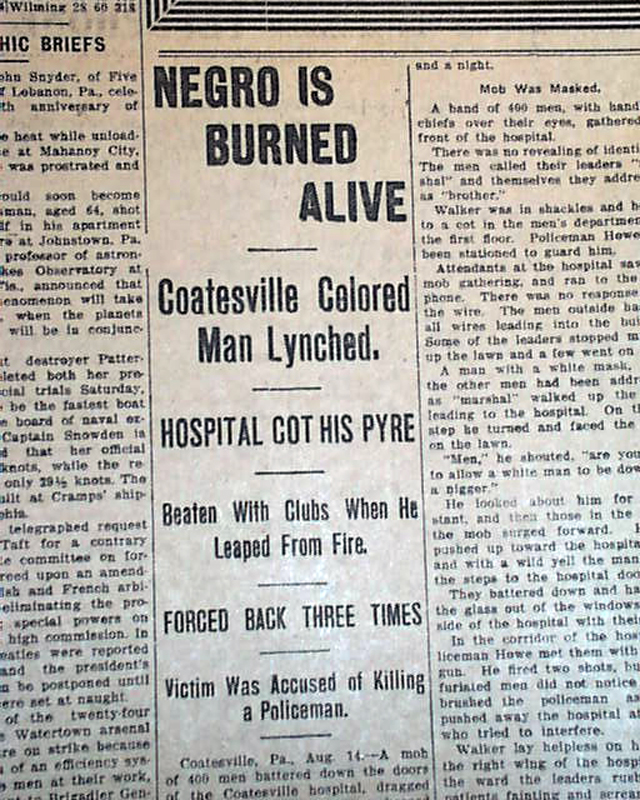
TOW #22: Coatesville by John Jay Chapman, The Best American Essays of the Century


On August 1912, John Jay Chapman gave a speech commemorating the lynching of an African-American man in Coatesville, Pennsylvania. He shows his disgust towards those who watched the lynching and towards the American people for allowing these racist, heinous crimes to continue to occur. Throughout his speech, he uses asyndeton and a condescending tone in order to push listeners to move away from this hatred and towards a love for everyone regardless of race.

In his speech, Chapman uses asyndeton in order to put emphasis on the topic at hand. He says, “I say that our need is new life, and that books and resolutions will not save us, but only such disposition in our hearts and souls as will enable the new life, love, force, hope, virtue, which surround us always, to enter into us.” By not including an “and” when listing “life, love, force...” he is able to speed up the pace of his speech, overall putting emphasis on the gravity of what he is saying. Listeners can fully appreciate and be drawn in on what Chapman has to say.

Chapman also uses a condescending tone towards the American people and America in order to show his disgust towards the deep-rooted hatred that lingers on even fifty years after slavery was abolished. He says, “I saw a seldom revealed picture of the American heart and of the American nature. I seemed to be looking into the heart of the criminal – a cold thing, an awful thing.” He compares America to a criminal to show his ill-felt emotions towards the racist and heinous crimes in America. By doing this, he can instill shame into his audience and make them want to end the hatred in their country.

Overall, by using asyndeton and a condescending tone, Chapman is able to successfully argue that America needs to shift its mindset towards African Americans and plead the American people to stop letting such wicked acts of hate as lynchings plague the country. Though only two people came to listen to his speech, the transcript was published in Harper’s Weekly, extending his audience all across America.

(http://images.rarenewspapers.com/ebayimgs/11.90.2012/image054.jpg)

Sunday, March 5, 2017

TOW #21: Political Cartoon on the Two-Party System

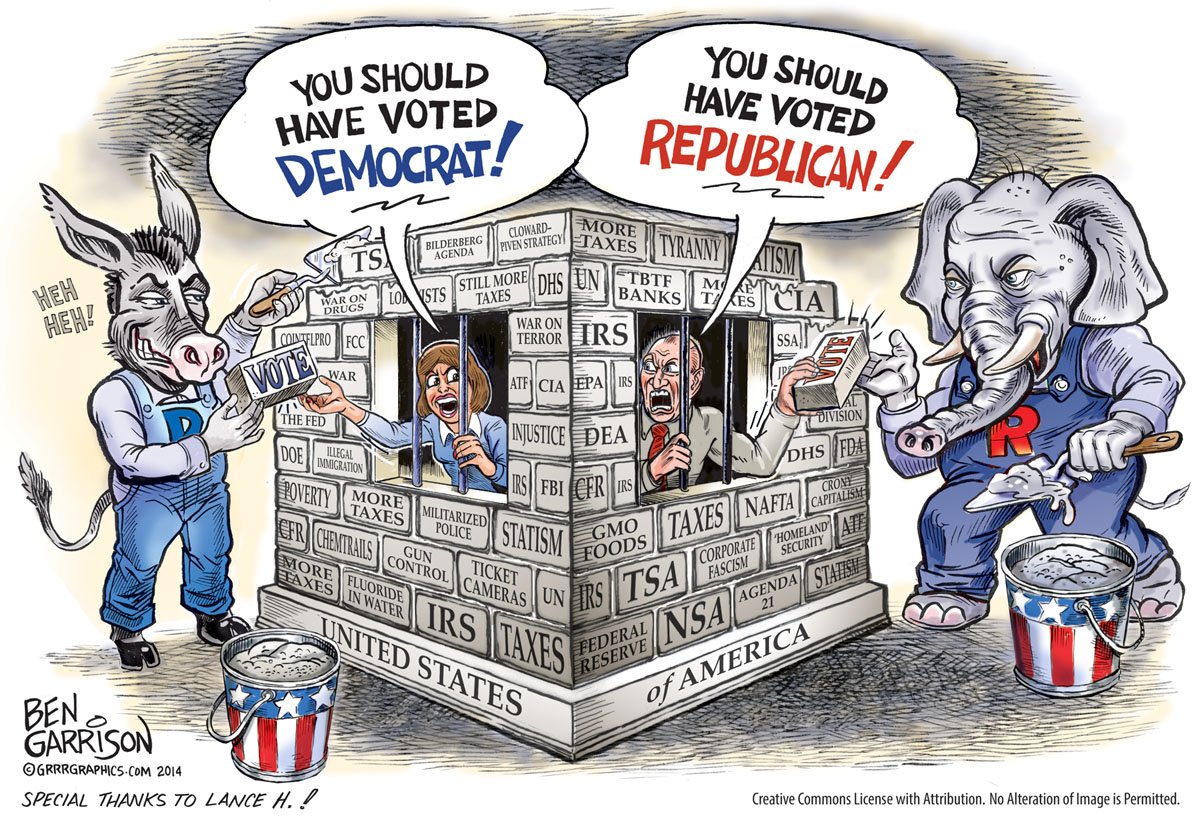
This modern-day political cartoon by Ben Garrison gives commentary on the two-party system in the United States. It uses metaphors and irony in order to make its point that America needs to move away from this system that forces the government to be either Democratic or Republican.

In this cartoon, Garrison uses metaphors in order to simplify the problems that arise with the two party system into a simple situation of people being trapped in a prison cell. The donkey and elephant represent the Democratic and Republican parties, respectively, and the prison cell represents the system trapping its people. Each of the bricks in the cell are either parts of the each party’s platform or something that the party has done to hurt America. The animals have dubious looks as they are purposely cementing the bricks on the man’s and woman’s prison cell. This whole metaphor shows how the people’s vote either goes to the Democrats or the Republicans, and not any other party. It shows how each party has done negative things on either end of the political spectrum to hurt the American people.

This cartoon also uses irony in order to depict how the people are buying into this system and are doing little to break away from the two-party system. In the cartoon, a man and a woman hand a brick that says “vote” to the donkey and the elephant. They are arguing their end of the political spectrum instead of realizing that their vote is trapping them into the problems that have arisen in America. The irony is that they are allowing the system to hurt them and are too busy arguing to even see the bigger picture that both parties can be harmful to America. Additionally, each political party seems to care more about getting the vote then thinking what is best for the country and will not cooperate to make America a progressive nation. This makes viewers realize that the two-party system needs to change.

By using metaphors and irony, Garrison successfully portrays how there needs to be a change to the political structure in America, as the two-party system is hurting the American people.


Sunday, February 26, 2017

TOW #20: "Think Like a Freak" by Steven D. Levitt and Stephen J. Dubner, IRB

In Think Like a Freak, Steven D Levitt and Stephen J. Dubner discuss how to think more productively, more creatively, and more rationally to help improve readers’ abilities whether it be in business, sports, politics, etc. They use a direct tone and use controversy in order to push people to, as they call it, “think like a freak.”

In this book, Levitt and Dubner use a direct tone in order to be direct to readers and push them to think a certain way. When talking about finding the real facts, they say, “Don’t listen to what people say; watch what they do.” In order to convey their point that what people say they do does not necessarily reflect what they really do, they are very direct to the reader. They command the reader by saying “Don’t do this but do that.” This addresses the reader directly, which is something that is important in this style of book. Because Levitt and Dubner are try to teach a different way of thinking, they must speak right to the reader in order to be explicit with what they want the readers to do.

They also use controversy in order to promote this different way of thinking. When talking about problem solving, they say, “When it comes to solving problems, one of the best ways to start is by putting away your moral compass.” What they are trying to say is in order to find the true facts about things that would help you solve a problem, you must refrain from trying to determine what is morally right from what is morally wrong and you need to try to determine what is factually right from what is factually wrong. Many people would unconsciously use their morals when trying to solve problems, which is restrictive. The authors are teaching something that many might not want to hear since morals play a huge role in life. Yet, what they are saying is very rational, which fuels the controversy.

Overall, Levitt and Dubner are very successful by using their foundation of rationality to teach things in a direct and controversial way.

Rational Thinking
(http://themileage.org/wp-content/uploads/2014/12/research-2.jpg)

Monday, February 20, 2017

TOW #19: Microsoft “Empowering Us All” Ad


In its “Empowering Us All” advertisement, Microsoft displays how far technology has taken us and ponders how far we can take it in future years. It uses rhetorical questioning, parallelism, and awe-inducing imagery in order to show how it has empowered many and to promote its own (Microsoft’s) influence on helping the world.

In this advertisement, Microsoft asks rhetorical questions in order to make viewers reflect on how far technology has taken us and how it has helped many. It asks, “What is technology? What can it do? How far can we go?” This questioning helps the reader think about the positive impact of technology on the world and on many in need. It instills awe in viewers as they realize how technology is empowering people to be the best they can be despite any disposition they might have.

These questions are, in a way, answered by using parallelism in order to instill more of a sense of awe, and drive its point into the readers that technology empowers. It says, “[Technology] gives hope to the hopeless. And it has given voice to the voiceless.” This parallelism, though short, has a huge impact on the viewers. It draws emotions of joy from the reader as it makes them realize that technology can help disabled people become less disadvantaged, as it gives something to them that they never had before.

However, this alone is not enough to draw as much emotion as the advertisement did. Its joy-provoking diction was coupled with awe-inspiring imagery in order to sell the point that Microsoft is leading this movement in socially impactful technology. Short clips of the disabled becoming abled with technology, such as a child given the ability to walk with prosthetic legs, a woman given hearing with cochlear implants, and a man given a voice with speech-generating technology, were played throughout the advertisement. This allows people to see the full effect of the positive impact of technology, and instills a sense of awe in the great things it has done. Much of the technology displayed in this advertisement comes from Microscope, which helps users to believe that Microsoft is the head of socially-impactful technology. This overall influences viewers to support Microsoft as consumers.

All in all, Microsoft’s “Empowering Us All” ad appeals heavily on the viewer’s pathos in order to invoke the joy and awe of technology. By doing this, it truly displays how technology empowers us all despite any disabilities.

Speech-Generating Device
(https://pbs.twimg.com/media/CDOkNvPUgAAilP-.jpg)

Sunday, February 12, 2017

TOW #18: “Why Did Human History Unfold Differently On Different Continents For The Last 13,000 Years?” by Jared Diamond

In the article, “Why Did Human History Unfold Differently On Different Continents For The Last 13,000 Years?” Jared Diamond ponders why some societies in the world have become so technologically advanced while others have lagged behind tremendously, and he discusses many factors that could have affected the rate of development in different continents of the world. He uses compare and contrast along with reverse chronological hypophora to trace the roots of societal development.

Diamond uses the overall structure of comparison and contrast between two different continents at a time to give a focused view on how one continent developed faster than the other. He first compares Eurasia to the Americas, then Eurasia to Africa, and then finally Eurasia to Australia to find out how this huge land mass could develop to be so much more advanced than the indigenous people of other continents. By doing this, Diamond can give the audience a clear view on his theories from a small scope. If he had just compared everything all at once with a macroscopic view, this would have confused the reader as they would have trouble following Diamond’s train of thought.

In order to carry out his compare and contrast, though, he uses hypophora to trace history back farther and farther. A good example of this is when he asks how Europe could dominate America so easily and he answers by saying they were more technologically advanced in the 1500s. Then, he asks, “But how did the world evolve to be the way that it was in the year A.D. 1500?” By continually asking the question “how,” he is able to, as he states it, “push the chain of causation back further,” and is able to find the initial causal points that spurred different rates of development 13,000 years ago.

Overall, by using hyper-focused compare and contrast and reverse chronological hypophora, Diamond is able to clearly convey his theories on why some cultures developed much faster than others and were able to conquer other cultures.

https://www.edge.org/conversation/jared_diamond-why-did-human-history-unfold-differently-on-different-continents-for-the

Wednesday, February 8, 2017

IRB #3 Post

For this marking period, I have chosen to read the book Think Like a Freak by Steven D. Levitt and Stephen J. Dubner. It uses storytelling and analysis to teach readers how to think more productively, creatively, and more rationally to solve problems and "hack" life. I have chosen to read tis book since it will be very captivating and it is applicable to al aspects of life from sports to business. 

Book Cover

Sunday, February 5, 2017

TOW #17: “Why the Voting Age Should Be Lowered to 16” by The Economist

In the article, “Why the Voting Age Should Be Lowered to 16,” The Economist discusses the growing problem of diminishing voter turnout rates in America within younger demographics and proposes the solution to lower the minimum voting age to sixteen years old. The article argues that this will help get people into the habit of voting at a younger age and push them to see it more as a duty than a choice.

While I do think this is not the perfect solution to this problem, this could be a step in the right direction for bringing up the voting rates of younger generations. In 2007, Australia became the first world power to lower the minimum voting age to sixteen years old. In effect, the voting percentage of Australian minors became larger than that of Australians ages nineteen to twenty-five. Also, during a general vote in Scotland, sixteen-year-olds were allowed to vote, also causing the voting percentage of minors to become larger than that of ages nineteen to twenty-five. I do agree that a lowering of the voting age can lead to the increase of voting participation and also push younger generations to get into the habit of voting while they are still living with their parents.

However, I do not think that allowing minors to vote is a smart solution to this problem since they are just too young. Many people this age would not be mature enough to come to a knowledgeable, independent decision and would most likely be influenced by who their parents voted for. Instead, I believe that the best solution to this problem of declining voter rates lies in the classroom education of government. If more students are fully informed about current civic and political issues, this would naturally spark their desire to vote.

While this author wants to solve a huge problem in the voting of this country, I do not believe that his solution is viable. It is too optimistic and ignores the fact that minors can be immature when it comes to voting.

(http://imamsonline.com/blog/wp-content/uploads/2015/05/voting.jpg)

Sunday, January 22, 2017

TOW #16: Kansas-Nebraska Act Political Cartoon

Political Cartoon
(http://cf.collectorsweekly.com/uploads/2014/10/Slavery_Free_Soiler_cartoon.jpg)

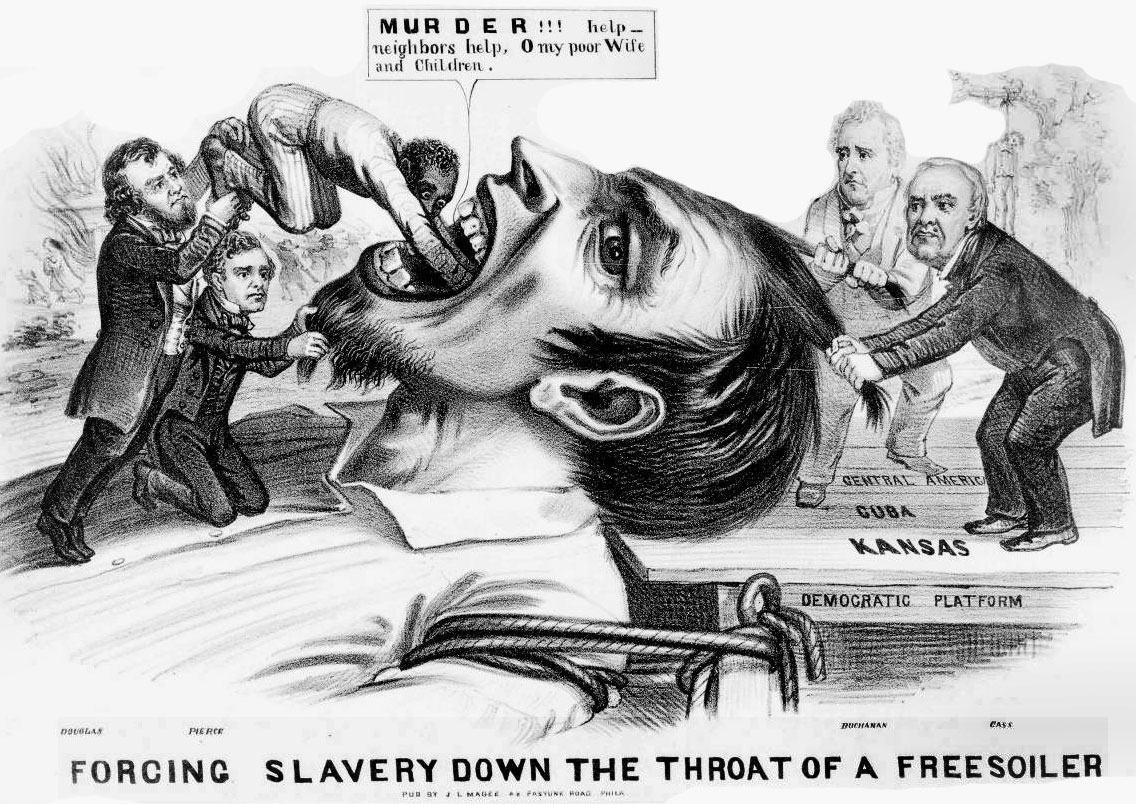
In 1820, the Missouri Compromise was passed to keep the balance between free and slave state power. It declared that slavery was illegal in the future Western states north of the 36º30’ latitude line. However, thirty-four years later, democratic congressman Stephen Douglas pushed to repeal this act and enact the Kansas-Nebraska act. This law would admit the Kansas and Nebraska territories, both north of the 36º30’, as states and would allow the people of the territories to vote on whether slavery was admitted or not. Since this directly went against their initial agreement with the South about slavery, the North was outraged. Additionally, the South was secretly scouting out possible slave states in Central America and Cuba. When the North found out, tensions grew even greater, and they felt as if the South (especially the southern Democrats) was “forcing slavery down [their] throats.” Since the Democrats seemed to be forcing the issue of slavery on the northern free soilers, the North created this cartoon to lash out against them, using gruesome imagery and literal representations to express their concerns.

The cartoon contain lots of gruesome imagery, such as the slave being shoved down the throat of a man by four democratic figureheads, a burning house with a mother and her children fleeing from it, and the lynching of a man. All of these scenes are used to draw out the audience’s (the people of the North) fear of and hatred for the Democratic Party, whose actions are being portrayed as heinous. This creates the effect that because of the its actions, it raised has raised violent conflicts against everyone regardless if they are a father, a mother, or a child. It shows the Democrats as the aggressors which successfully pushes the audience to outcry against such actions.

This cartoon also uses the literal representation of the conflict. This includes a literal interpretation of the idiom “to force something down one’s throat” as a slave being forced down the free soiler’s throat and of the Democratic platform as a literal platform. Because of this, it is easy for the audience to interpret the main problem at hand, easily moving people to have a public outcry against this problem.

Overall, this cartoon portrays the northern free soiler view of the Kansas-Nebraska Act along with their view of the south trying to expand to Latin America as a ploy to strengthen southern power and slavery. Through its imagery and literalness, it successfully conveys its point and contributed to the uprising against this act that led to the rise of the Republican Party.

Monday, January 16, 2017

TOW #15: IRB, The Grand Design by Leonard Mlodinow and Stephen Hawking

In The Grand Design by Leonard Mlodinow and Stephen Hawking, it talks about new theories of quantum physics that explain the existence of many paradoxical situations in the universe. Before these theories, traditional physicists could not logically explain how these situations work. This modern idea quantum physics has helped put a dent in understanding the perplexities of the universe, and it is the purpose of this book to share these new findings with the world.

Of course, since many of their theories are used to explain the unexplainable, Hawking and Mlodinow have to convey the information in a certain way in order to allow the audience to have a clear understanding of it. They do this by creating a problem-solution structure in each chapter, where they pose a problem that seems to be impossible to solve, and then they explain it using their theories.

Hawking and Mlodinow do this one way by posing the problem in a straightforward way. For example, they say, "The problem is, for our theoretical models of inflation to work, the initial state of the universe had to be set up in a very special and highly improbable way." (130). Their scientific, yet common, diction (e.g. saying “improbable”) allows them to introduce the problem. However, many times they introduce the problem using rhetorical questions. For example, they say, “If the total energy of the universe must always remain zero, and it costs energy to create a body, how can a whole universe be created from nothing?” (180). This is a great example of a paradox by asking the reader how the universe can be created from nothing because it perplexes and stumps them. They are forced to come up with a way to explain it, paving the way for the authors to give their theories that explains it. Rhetorical questions are utilized very effectively and they help to move the book forwards through its problem-solution structure.

Overall, Stephen Hawking and Leonard Mlodinow are posed with the difficult task of using quantum physics to explain complicated and seemingly-impossible situations that occur in the universe. However, they are able to effectively explain their ideas using their problem-solution structure, and it is through this, that they are able to help the common people to further understand where we originated from and how the universe works.

The Universe
(http://ichef.bbci.co.uk/wwfeatures/wm/live/1280_640/images/live/p0/3x/sw/p03xsw49.jpg)

Saturday, January 7, 2017

TOW #14: The Speech of Alexander the Great


In 335 B.C., Alexander the Great and his army began a conquest to expand the Greek Empire. For ten years, they went undefeated in all the battles they fought and they had successfully conquered Egypt and the vast Persian Empire. However, power-thirsty Alexander lusted for more and decided to continue his conquest to India. The men, who had become weathered by all the years of warring, had low morale and lacked the will to continue the conquest any longer. In his powerful speech, Alexander the Great used rhetorical questions, rallying diction, and a strong balance between logos and pathos in order to motivate his men to continue on.

In the beginning part of his speech, Alexander the Great used empowering rhetorical questions and diction to force his men to realize how strong they were and make them thirsty for more. After listing all of the places they had conquered, Alexander says, “With all that accomplished, why do you hesitate to extend the power of Macedon− your power− to the Hyphasis and the tribes on the other side? Are you afraid that a few natives who may still be left will offer opposition?” In the first question, he emphasizes “your power” in order to make his troops realize their great abilities and show that a little more conquesting will not pose a threat. Then, in the second question, he plays the “scaredy-cat” card, teasing his men and their dignity. He asks his men if they are scared of “a few natives” as reverse psychology to make his men realize that fighting means keeping their dignity.

In the central part of his speech, Alexander the Great transitions by using a more logical approach. He explains to his men that if they do not conquest India, then someone else will. He says, “Should that happen, all that we have done and suffered will have proved fruitless--or we shall be faced with the task of doing it over again from the beginning.” For the sake of progress, he able to convince his men that if they do not conquest India, all of their past conquests were for nothing and they might have to start over. This appeal to the soldiers’ logos forces them to understand that the only logical option is to continue on.

In the end, Alexander the Great transitions back to appealing to the soldiers’ pathos by glorifying them and using a “we are in this together attitude.” He says, “We have passed beyond Nysa and we have taken the rock of Aornos which Heracles himself could not take.” Alexander focuses on the fact that his men has taken land that Heracles, a demigod known to be stronger than any man and even some gods in Greek mythology. This is a rallying call for the soldiers because if they can conquer land that Heracles cannot, what can’t they do? He continues, and says, “You and I, gentlemen, have shared the labour and shared the danger, and the rewards are for us all.” His word choice of “you and I” helps to unify his men and make them feel a bond through the battles they fought. By ending this way, he paves the path to continuing the conquest to India.

Alexander the Great’s ambitions did not line up with those of his men, who were tired of fighting, and he realized that they needed to be motivated for one last conquest. By using his awe-inspiring oration skills learned from the great Aristotle, he was able to successfully rally his men and continue on to India.

To read his speech, click here.

Alexander the Great
(http://www.pindex.com/uploads/board_cover_images/original/image_2522.jpg)