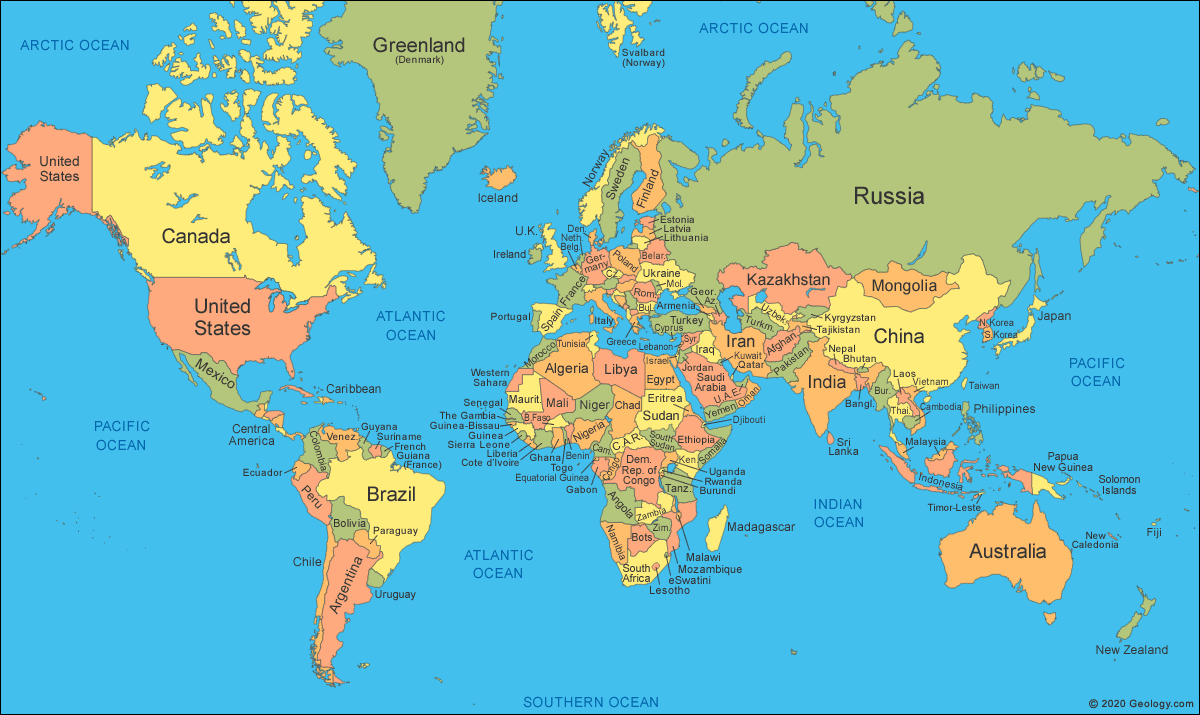
Diamond uses the overall structure of comparison and contrast between two different continents at a time to give a focused view on how one continent developed faster than the other. He first compares Eurasia to the Americas, then Eurasia to Africa, and then finally Eurasia to Australia to find out how this huge land mass could develop to be so much more advanced than the indigenous people of other continents. By doing this, Diamond can give the audience a clear view on his theories from a small scope. If he had just compared everything all at once with a macroscopic view, this would have confused the reader as they would have trouble following Diamond’s train of thought.
In order to carry out his compare and contrast, though, he uses hypophora to trace history back farther and farther. A good example of this is when he asks how Europe could dominate America so easily and he answers by saying they were more technologically advanced in the 1500s. Then, he asks, “But how did the world evolve to be the way that it was in the year A.D. 1500?” By continually asking the question “how,” he is able to, as he states it, “push the chain of causation back further,” and is able to find the initial causal points that spurred different rates of development 13,000 years ago.
Overall, by using hyper-focused compare and contrast and reverse chronological hypophora, Diamond is able to clearly convey his theories on why some cultures developed much faster than others and were able to conquer other cultures.
 |
| https://www.edge.org/conversation/jared_diamond-why-did-human-history-unfold-differently-on-different-continents-for-the |

No comments:
Post a Comment